Friday, December 3, 2010
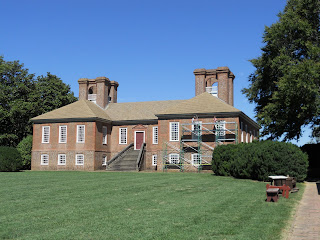
Preparing the Great House for Winter
First, we decide on a theme for the Christmas program. This year Jon Bachman, our Educational Events Coordinator, picked a year - 1774 - as the interpretive theme. Having one particular year gave me a good starting point for deciding how to set up the house appropriately. Then I took some time looking at Lee family papers (like the 1776 household inventory) and period accounts (like the diaries of planter Landon Carter and local schoolmaster Philip Vickers Fithian). Pulling information from secondary sources came next (At Home and The Festive Tradition are two favorites).
I then spend a lot of time writing a memo (11 pages this year) to outline the stories I want to tell in each space. The Blue Bedchamber, for instance, is set up loosely based on a diary entry of Landon Carter where he is taken ill with colic (abdominal pain and constipation) after eating a dinner of pork and oysters. Carter describes taking a syrup of white walnut bark and molasses, and as a result goes "with ease to the close stool pan twice." The diary entry is a rather graphic description of his bathroom habits and we have a close stool (toilet) pulled out in the room along with a glass of the syrup sitting nearby to help interpret this.
The Dining Closet is set up with a hunt breakfast: cold meat and vegetables, bread, hoecakes, and hot coffee. Here we take the opportunity to talk about outdoor activities in the wintertime. Did you know that included in the 1776 household inventory was a pair of snow shoes? Well, fox hunting was a favorite pastime and you can see the gentleman eating breakfast here before their big hunt begins. A couple of hats and a wool great coat lay nearby awaiting their departure.
Downstairs, a number of rooms help illustrate how the slaves and servants experienced the holiday season - some receiving gifts from their masters (coins and bottles of rum) and others with more work to do. The holiday season was a time of merriment for the Virginia gentry, but for their household slaves and servants it was a busy season full of extra guests and fancy dinners and dances. You see the Servants Hall set up as though some of the indentured and hired servants have been able to carve out a few free moments to enjoy some food and fellowship before being called to their next task.
That's just a sneak peak of what we have going on in the Great House this holiday season. Come see it all aglow on December 11th and throughout December, January, and February.
Landon Carter quote: Jack P. Greene, ed., The Diary of Colonel Landon Carter of Sabine Hall, 1752-1778, II (Richmond, Va., 1987), p. 908.
Friday, November 19, 2010
Fun on the Farm: Perspectives from an Intern
Hi folks, my name is Townsend Hart and I’m a historic preservation and museum studies minor at the University of Mary Washington. I’m currently interning with both Gretchen Goodell (Curator) and Abigail Newkirk (Director of Interpretation and Education).
The objective for the internship is to research various objects belonging to Stratford and create interpretive proposals. Initially I planed to work on five objects in total, but some of the objects required more in depth and time consuming research. It has really been a learning experience and I’m thankful for the opportunity to do such involved, fascinating projects.
The first object I began with
was the nursery fireback- marked with two cherub angels and the date 1745. I was able to find some interesting things about both this particular fireback as well as firebacks in general. For example, the fact that the Lee’s even had one greatly tells of their wealth considering firebacks were rare and only in the possession of the upper class at the time. To complete my research I looked through archival information (early RELMA notes, Lee family member accounts), books on iron works, and Robert E. Lee biographies.
The second object that I worked with was a handwritten book of Sermon’s attributed to Hannah Lee Corbin (originally dated to around 1780). My initial task for the book was to determine who actually penned the book because there is no name written. For this I completed a handwriting analysis comparing some letters written by Hannah Lee Corbin and her son-in-law George Turberville. Next I attempted to find a single original source...what a crazy experience this was! Google Archives proved to be an excellent resource. I was able to search an individual sentence and come up with original sources, many from 18th century journals. If it was Hannah Lee Corbin who penned this, it really shows her moxie and intelligence.

I have loved getting to see the inner workings of a historic house museum first-hand. There really is no better environment to have this experience than at Stratford. I enjoy taking breaks to feed the horses, or Zander and Steve as I call them, but I highly doubt these are their actual names. I’m looking forward to making way on my next project: thinking of something cool for the coaching event in the spring as well as come up with some creative ideas for the interpretation of the coach house.
Thursday, November 4, 2010
Hands-on History
Most history buffs and museum enthusiasts have a specific memory of being at a museum as a child (sometimes called "sticky memories" because we remember vivid details even as adults). Sometimes it is a story that was told, or a specific room. Often it relates to a game or activity...something that could be touched. Accomplishing this in a historic house like Stratford Hall can be difficult, so this fall the new Hands-On Activity Room was opened. Located in the East Slave Quarters, this room is designed to be family-friendly. We first blogged about the project in April.The building is located to the south-east of the Great House and furnished with child-sized furniture, a colorful rug, costumes to play dress-up, and building blocks. The centerpiece for this new room is a custom made Discovery Chest. This piece of furniture has nine drawers filled with books, stuffed animals, dolls, fake food, shark teeth, and colonial games. Each drawer has a box that can be lifted out, allowing families to bring the items to the carpet or tables to play.
This area will continue to grow and evolve as we get feedback from our youngest visitors, but a great step forward in providing families with a memorable experience at Stratford Hall!
Tuesday, October 26, 2010
The new Slave Quarters Exhibit
The exhibits in the West Slave Quarters have been updated and are now open to the public. If you would like a refresher on all our activities this summer, please read our posts about Restoration of the Slave Quarters and Furnishing Plan for the Slave Quarters.
The first pieces to
go into the new spaces were the new barriers. Andrew and Eric from AK Metal Fabricators spent two days at Stratford Hall to install our new barriers. The design is the same as those used in the Southwest Outbuilding. These barriers will protect the collection, allow visitors a clear view of the exhibit, and stand-up to the elements. They also pivot open, making cleaning and maintenance very easy.
Our next component was the new text panels. Neal and Doug from Gropen spent a day installing text panels and reader-rails (text panels that sit on top of our barriers).The last installation was the archaeological samples. Built-in to our new reader-rails are archaeological boxes. These plexi-glass boxes contain archaeological finds that were discovered around the Slave Quarters and provide insight into the lives of the slaves who lived here. The final step was for Curator Gretchen Goodell and Collections Manager Sarah Holland to move the artifacts and furniture into the new exhibits.
Below are some more images of the finished exhibit. Next week we will highlight the new Hand-on Activity Room.

Thursday, September 16, 2010
So that is what the scaffolding is for...

The layers of paint are being removed using infrared heat and scrapers. Once the paint is removed, any required preservation of the wood can be done. The entire cornice will then be primed and repainted. This is a very labor intensive project that will continue throughout the fall and continue in the spring (work will stop for the winter months).
While you may not notice a huge difference the next time you visit us, this type of work is an integral part of the preservation of Stratford Hall.
Thursday, August 26, 2010
Women's Equality Day
Much like her
We do not know the architect of Stratford Hall, but Thomas and Hannah’s eldest son provided a hint when he mentioned that he regretted Hannah’s taste had been followed in the design.
Alice Lee was a young teenager when her parents died. Giving up hope of receiving her inheritance from her father’s estate, in 1760 she went to England where she met and married William Shippen, Jr. of Philadelphia. During the meeting of the Continental Congress in Philadelphia, she and her husband entertained her brothers and other important revolutionary figures, such as the Adamses. Alice Lee Shippen actively collected money in Philadelphia to support the American troops and accompanied her husband (appointed Director General of Hospitals in April 1777) at several encampments of Washington’s army. These encampments included Middlebrook, NJ, Reading, PA, and Valley Forge, PA.
Alice's sister also expressed views that were not typical of the time. Hannah Lee married Gawen Corbin II of Pecatone Plantation. When Gawen died in 1759, his will stated that Hannah would forfeit the estate if she remarried. Rather than lose the property, Hannah entered a common law marriage with Dr. Richard Lingan. Dr. Lingan moved into Pecatone and there they raised their two children.
In 1778, Hannah Lee Corbin wrote her brother Richard Henry to advocate for voting rights for women landowners. Richard Henry's response (dated March 17, 1778): "Perhaps 'twas thought rather out of character for Women to press into those tumultuous Assemblies of Men where the business of choosing Representatives is conducted."
Tuesday, August 17, 2010
Slave Quarters Exhibits On The Way
You've heard already about the preservation work currently in progress, and the planning for educational hands-on and classroom space that will open in the east building in the coming months. But remember I mentioned that there are two buildings? What about the west building (the one closest to the Great House, pictured above)? In October 2010 we'll be revealing a brand new exhibit space in this structure. Designers are putting the finishing touches on the text and graphic panels. I'm working feverishly on lists of museum objects and appropriate reproduction objects to furnish the two lower-level rooms (the building is a double quarter for two families, with main living rooms below and attic lofts above). And Sarah, our collections manager, is getting dirty this week as she tries to safely clean and move the historic furnishings out of the spaces and into storage.
What will you see when we reopen the space in October? You will see two separate living spaces. One will house an enslaved gardener named Anthony (he appears in a 1776 inventory) and other skilled male workers. I am hesitant to call this a "bachelor" household, though. Slave women often worked as field laborers, so perhaps the single men living here had wives and children that they visited on Sundays and holidays at outlying farm quarters away from the Stratford home farm.
The other living space will be furnished to represent a female domestic family, specifically a woman named Nelly and her daughter Mary. Nelly and her child Mary appear in a 1776 estate inventory, and we find Mary again in a 1782 slave list with the descriptor "blind" after her name. What was life like for Mary? That's just one topic we'll touch upon in these new exhibits.
You'll also soon see on display fragments found in archeological digs in the area. We've included things like a stoneware and creamware dish fragments, a sewing needle, and a shell button. Artifacts that indicate that slaves were consumers. They purchased fashionable goods using money earned by raising and selling vegetables and other goods, or bartering their skills.
This project has been in the research and development phase for close to two years, drawing upon period documents, archaeology, and current scholarship. Stay tuned for the big reveal in October. We look forward to having you visit and hearing what you think!