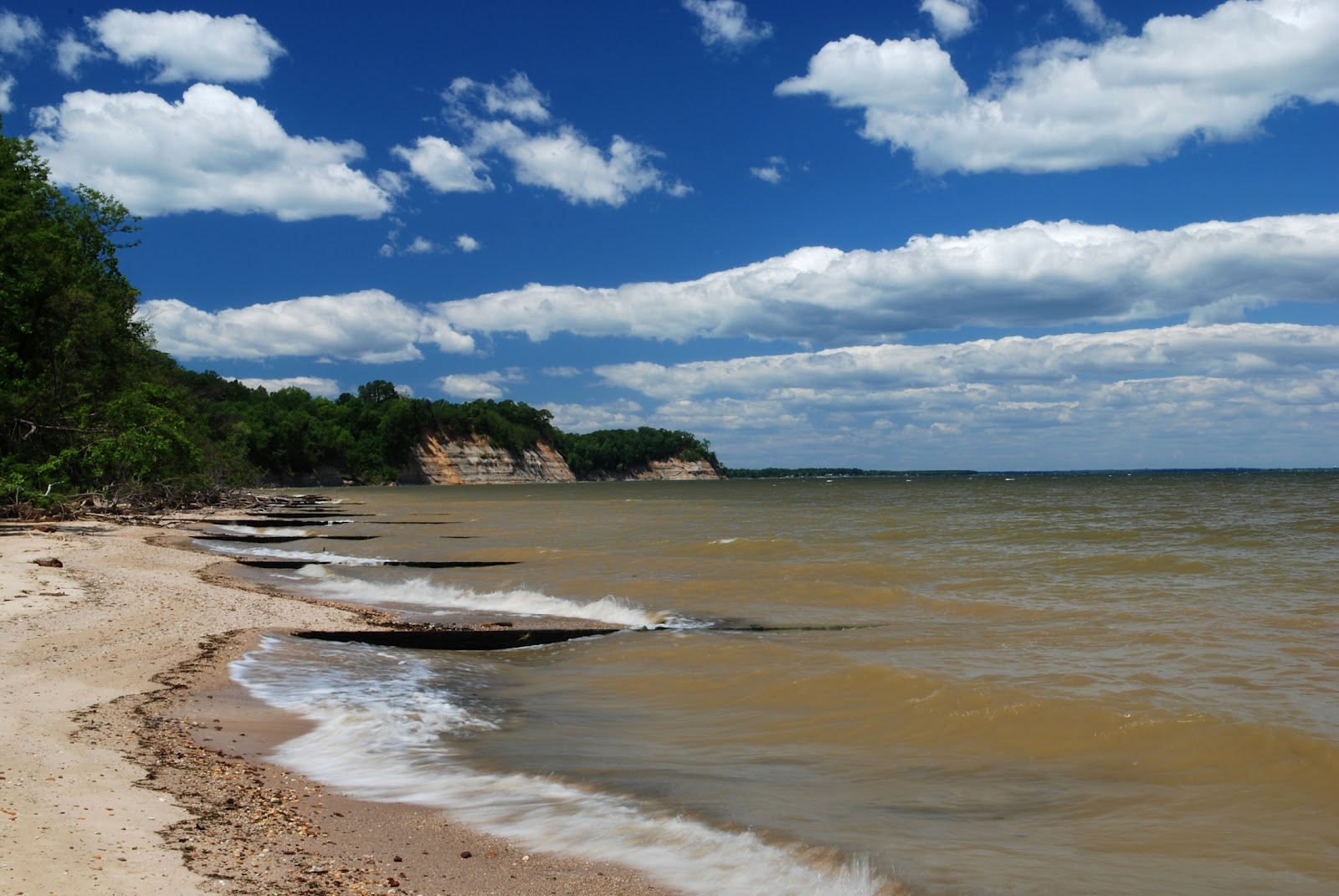
 Towering over 100 feet about the Potomac River are the famous cliffs of Stratford Hall. Within the deposit that make up the cliffs are the evidence of animals and plants that lived here long before the first hunter walked the shores. For thousands of years most of these remains went unnoticed.
It would not be until the mid 19th century that geologists began to piece together information that would lead to geological principles. Of these principles, the most significant is called superpositioning. This is a geological term applied to the observation that the oldest deposits are at the bottom the youngest are found at the top in a layer cake of time. The Stratford cliffs make up a unique layer cake and are part of the geographic region known as the Virginia Coastal Plain. The Virginia Coastal Plain is part of the much larger Atlantic Coastal Plain.
The specific layers at Stratford Hall are known to paleontologists and geologists as the Miocene Chesapeake Group Formations or Calvert Group. At Stratford Hall, these sediments span a time period from about 16 million years to the present day.
The sediment and silts, which formed the cliffs, are the result of millions of years of erosion and ocean sediment accumulation. These sediments were deposited in a prehistoric bay known as the Salisbury Embayment. The Salisbury Embayment was an arm of the Atlantic Ocean which covered what is now Delaware, southern and eastern Maryland, the Virginia Peninsula, and parts of southern New Jersey during Tertiary times (about 65 million to 5 million years ago). Sea level throughout most of this period stood several hundred feet higher than at present and deposition of sediments draining off the continent possibly caused the underlying rocks to sink down, creating the embayment. The shore of the embayment lay inland at the present-day fall line in the region.
This bay was a shallow-shelf open marine setting and lagoon environment. Vertebrate assemblages such as rays, sharks,and ocean going crocodiles frequented the bay for food sources. Diverse invertebrate groups colonized the shallow and near shore environments.
 |
| Examples of teeth from an extinct sharks |
When sea levels fell as the Pleistocene ice ages took hold, the thousands of feet of sediment layers in the Salisbury Embayment were exposed as the Coastal Plain terrains of Delaware, Maryland and eastern Virginia.
The various layers of the Calvert group are seen as bands of various colors rising from the river shoreline. Each color of sediment seen indicates a unique variety of sediments resulting from recurring pulses of marine advances and retreats over the millennia. These pulses were the accumulating deposits of silts, clays, and sands that sealed the remains of the animals and plants. Each of the layers holds a unique groups of fossils.

At Stratford Hall, the oldest sediments are visible at the water line. This is the Calvert formation (16 million years old). The next deposits up about 40 feet are the Choptank formation. The St. Mary’s formation rises above the Choptank. Rising above the St. Mary’s for about another 20 feet, is the Eastover formation of late Miocene age (5 million years old). Above the Eastover is the Yorktown formation of early Pliocene time. (1-3 million years old) The last layers, closest to the top of the cliffs, is the Pleistocene or ice age deposits (1.5 to 12,000 years old). At the very top is what geologists refer to as Holocene deposits. This is the geological epoch which began at the end of the Pleistocene (around 12,000 years ago and continues to the present).
It is not permitted to dig into the cliffs. The dangers are real. The unstable nature of the sediments results in frequent falling sections of cliff, and smaller avalanches are constantly occurring. Beach collecting is permitted in designated areas only.








 Posts
Posts

